Medovia Medical Medovia Medical

How to Use AI in Modern Lab Diagnostic Tools?

Time:2026-11-07 Author:Liam
0%

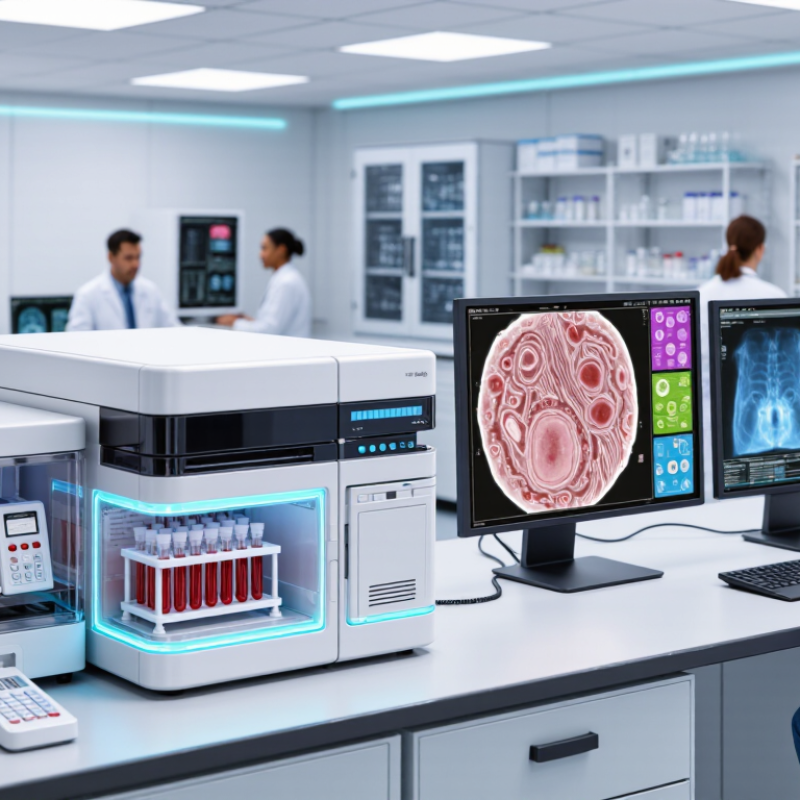
What is the impact of AI on modern lab diagnostic tools? It is changing how laboratories detect patterns, prioritize samples, and support clinical decisions. A blood analyzer can flag an unusual cell pattern for review. A digital pathology system can highlight a small region that might otherwise receive less attention. These tools do not replace the underlying test. They help people interpret its signals.

Stanford radiologist Curtis Langlotz is widely associated with this observation: “AI will not replace radiologists, but radiologists who use AI will replace radiologists who don’t.” His remark concerns radiology, but its broader point applies to laboratory work: human expertise remains essential. AI can assist with image analysis, quality checks, and workflow triage. Yet performance depends on representative data, careful validation, and monitoring after deployment. A model trained on one instrument or patient population may not perform equally well elsewhere. That matters.

For laboratory teams, practical adoption starts with a defined task, not a sweeping promise. Compare AI-supported results with established methods, inspect errors, and document when staff should override a recommendation. A flagged result still needs context, including specimen quality and the patient’s clinical picture. Even a fast algorithm can be confidently wrong. That is worth remembering. Used carefully, AI can make modern diagnostic tools more consistent and responsive; used without scrutiny, it can add complexity while hiding uncertainty.
How to Use AI in Modern Lab Diagnostic Tools?

Understanding AI’s Role in Modern Laboratory Diagnostics

How to Use AI in Modern Lab Diagnostic Tools?

Understanding AI’s Role in Modern Laboratory Diagnostics

AI can help laboratory teams review complex data more consistently. In digital pathology, it may flag unusual regions on a tissue slide for closer review. In clinical chemistry, algorithms can identify patterns across test results and highlight values that deserve attention. These tools support trained professionals; they do not independently establish a diagnosis. Their performance depends on reliable data, appropriate validation, and regular monitoring. A system trained on one patient population may perform differently elsewhere. That limitation matters.

Tips: Check whether a tool has been validated for its intended test and setting. Review flagged results alongside the original specimen and patient context. Track false alerts and missed findings, not just processing speed. Keep clear procedures for human review, software updates, and reporting concerns.

AI can also reduce repetitive work, such as sorting routine images or prioritizing samples. This may give staff more time for unusual cases. But a faster workflow is not automatically a safer one. Poor-quality images, inconsistent sample handling, or shifts in testing methods can affect outputs. Laboratories should document how staff use recommendations and assess performance after implementation. The technology is useful, but its limits need honest attention.

How AI Supports Modern Laboratory Diagnostics

A study of breast cancer lymph-node slides compared pathologist and deep-learning performance.

The area under the curve (AUC) measures how well a method distinguishes positive from negative cases; higher values indicate better discrimination. In this study, AI assistance helped pathologists achieve a higher AUC than unaided assessment.

Source: Ehteshami Bejnordi et al., JAMA (2017), “Diagnostic Assessment of Deep Learning Algorithms for Detection of Lymph Node Metastases in Women With Breast Cancer.” DOI: 10.1001/jama.2017.14585. Values shown as AUC × 100.

Preparing Laboratory Data for AI Analysis

AI tools learn from laboratory records, not from the intentions behind them. Before analysis, define what each field means, including units, specimen types, and collection times. A potassium result recorded in mmol/L should not be mixed with values in another unit without a verified conversion. Keep the original result and document any change. Small details matter.

Inspect missing values and unusual entries instead of automatically deleting them. A blank result may mean “not measured,” while zero means something different. Check labels against laboratory procedures and have qualified staff review ambiguous cases. Remove direct identifiers and apply approved privacy controls before sharing data. This sounds tidy; real workflows are not. Older instruments and revised protocols can leave inconsistent records that need careful review.

For model development, separate training and evaluation data by patient, site, or time when appropriate. Otherwise, near-duplicate records may appear on both sides and make performance look stronger than it is. Record the dataset version, exclusions, transformations, and reference method. Keep a small set of reviewed examples for checking whether the pipeline handles decimal points, units, and abnormal flags correctly. AI outputs still require expert evaluation; a clean dataset cannot remove every source of bias or error. A pilot can reveal problems, but it cannot prove readiness for routine use.

Integrating AI into Diagnostic Instruments and Workflows

Integrating AI into diagnostic instruments works best when it supports a clear laboratory task. In a hematology analyzer, for example, software might flag unusual cell images for technologist review. The instrument should display the image, the reason for the alert, and any relevant quality-control status. A score without context is hard to act on.

Small details matter.
A useful system fits the existing workflow: results move securely, alerts reach the right person, and uncertain cases can be reviewed without disrupting routine testing. Before deployment, laboratories should compare AI outputs with established methods across representative samples. Performance can vary with specimen quality, patient populations, and instrument settings. Validation is not a one-time checkbox.

After launch, teams need to monitor error patterns, turnaround times, and changes in sample mix. Clear procedures should explain when staff can accept a suggestion and when they must investigate further. AI may reduce repetitive review, but it can also create new queues or false confidence. That trade-off deserves honest measurement. Even a well-tested tool may behave differently on a busy Monday than during a controlled evaluation. Lab professionals remain responsible for interpreting findings in clinical context.

Validating AI Results for Accuracy and Safety

AI diagnostic tools should be tested like clinical instruments, not judged by a striking accuracy score. A 2020 review in The Lancet Digital Health examined 82 studies comparing deep learning with healthcare professionals. It reported that 81% of the studies were retrospective. That matters. Retrospective tests may miss changes in patient mix, specimen handling, or laboratory workflow. Before deployment, teams should test the tool on data from different sites and time periods, then compare its outputs with qualified human review.

In a lab, validation should mirror the bench: include routine and difficult specimens, record false negatives and false positives, and check performance across relevant patient groups. Measure calibration and failure rates, not accuracy alone. Not just accuracy. The NIST AI Risk Management Framework (2023) recommends ongoing monitoring because performance and risks can change after deployment. Keep a dated record of model versions, thresholds, test sets, and corrective actions. Recheck results after software updates or workflow changes. A clean validation table can still hide a weak reference standard; that deserves honest discussion, even when the finding is inconvenient. Human oversight should remain clear, with a defined route to pause use when results drift.

How to Use AI in Modern Lab Diagnostic Tools? – Validating AI Results for Accuracy and Safety

Validation Dimension Method or Measure Example Validation Data Safety Interpretation
Data status Illustrative, internally consistent example for a laboratory AI that flags digital microscopy images for possible abnormal findings. Example figures are provided to demonstrate how results can be reported; they are not results from a real clinical study or a universal performance claim. Use locally collected, appropriately governed data to establish actual performance before clinical use.
Intended use Define the specimen type, patient population, clinical setting, output, and role of the AI before testing. Example: AI provides a review-priority flag for microscopy images; a qualified laboratory professional makes the final interpretation. Do not use a triage or decision-support output as a standalone diagnosis unless that use has been specifically validated and authorized.
Reference standard Compare AI outputs with an independently established reference result, such as a final assessment by qualified reviewers using the laboratory’s validated procedure. Reference results should be assigned without access to the AI output; disagreements should be resolved using a prespecified process. Independent reference assessment helps reduce bias and makes errors traceable.
Validation cohort Use patient-level independent cases that were not used to train or tune the model. Example test set: 1,000 cases, including 200 reference-positive and 800 reference-negative cases. Document inclusion criteria, exclusions, specimen handling, site, and the time period represented. Avoid leakage of patients or images across training and test sets.
Confusion matrix Count true positives (TP), false negatives (FN), false positives (FP), and true negatives (TN) at the selected operating threshold. TP: 190; FN: 10; FP: 24; TN: 776. Total: 1,000 cases. Review false negatives for potential missed disease and false positives for unnecessary review or follow-up.
Sensitivity TP ÷ (TP + FN) 190 ÷ 200 = 95.0%. Example acceptance criterion: at least 95.0%, set in advance according to intended use and clinical risk. Sensitivity indicates how often reference-positive cases are flagged. A missed-case review is essential when false negatives could cause harm.
Specificity TN ÷ (TN + FP) 776 ÷ 800 = 97.0%. Example acceptance criterion: at least 95.0%, set in advance according to intended use and clinical risk. Specificity indicates how often reference-negative cases are correctly not flagged. Assess the workload created by false-positive flags.
Predictive values Positive predictive value (PPV) = TP ÷ (TP + FP); negative predictive value (NPV) = TN ÷ (TN + FN). PPV: 190 ÷ 214 = 88.8%. NPV: 776 ÷ 786 = 98.7%. The example test-set prevalence is 20% (200 of 1,000). PPV and NPV depend on prevalence. Recalculate or evaluate them in populations representative of the intended laboratory setting.
Subgroup performance Report sensitivity, specificity, and uncertainty by relevant groups, such as age range, sex, specimen type, and collection site, where appropriate and lawful. Set minimum sample sizes and subgroup acceptance limits before analysis; report groups with insufficient data rather than treating them as validated. Investigate meaningful performance gaps. Overall accuracy alone can conceal poorer performance in a particular group or setting.
Threshold and uncertainty Lock the decision threshold before final testing and evaluate borderline or low-confidence outputs. Record the threshold, version, confidence intervals, and the number of cases referred for human review or returned as indeterminate. Provide a defined human-review pathway for uncertain cases; do not force an automated result when input quality or model confidence is inadequate.
Operational safety Test image or specimen quality checks, system failures, result transmission, user overrides, and audit logging. Verify that invalid inputs generate a clear warning, AI results are linked to the correct case, and overrides and corrections are recorded. Keep a validated laboratory workflow and a documented fallback process available if the AI tool or connected system is unavailable.
Ongoing monitoring Monitor performance and input characteristics after deployment using approved procedures and scheduled reviews. Track error rates, referral rates, subgroup trends, input-quality failures, software or model changes, and user-reported incidents. Define alert thresholds, investigation responsibilities, corrective actions, and criteria for pausing use or repeating validation.

Note: Acceptance limits should be clinically justified and documented for the specific intended use. Performance should be evaluated on representative, independent data, with uncertainty and limitations reported.

Monitoring AI Systems in Routine Laboratory Practice

In routine laboratory practice, monitoring an AI system begins with the workbench, not the dashboard. Staff can compare its flags with verified results, review rejected samples, and note when instrument maintenance changes the data. A sudden rise in borderline classifications may reflect a new patient mix, a reagent lot, or a genuine model problem. Small shifts matter.

A useful monitoring log tracks performance over time, including missed cases, false alerts, processing delays, and results across relevant patient groups. Teams should set review limits during local validation, then define who investigates an alert and how decisions are recorded. One weekly check may catch a gradual drift that a monthly report hides. That is not enough, though: unusual patterns need timely review, not just tidy charts.

Keep a clear route for staff to question or override an output. Record the reason, the final result, and whether the case needs follow-up. Periodically compare AI-supported decisions with independent review, especially after workflow changes or software updates. A dashboard can look reassuring while hiding uneven performance. People still decide. That tension deserves attention, and monitoring plans should be revised when real practice exposes gaps.

FAQS

What can AI do in a diagnostic laboratory?

It can flag unusual tissue-slide regions, sort routine images, and highlight test values for review. It supports trained staff. It does not diagnose alone.

How should laboratories validate an AI tool?

Test it on routine and difficult specimens from different sites and time periods. Compare outputs with qualified human review. Accuracy alone is insufficient.

Why can retrospective testing be limited?

It may not reflect current patient groups, specimen handling, or laboratory workflows. Real conditions change. That matters.

What performance measures should teams track?

Record false positives, missed cases, calibration, failure rates, and processing delays. Review results across relevant patient groups. Not just speed.

How often should AI performance be monitored?

Set review limits during local validation and check results regularly. Weekly checks may reveal gradual drift. Unusual patterns need prompt attention.

What should staff do when an AI result seems wrong?

Compare it with the original specimen and patient context. Record overrides and reasons, then arrange follow-up when needed. People still decide.

What changes can affect AI outputs after deployment?

Patient mix, reagent lots, instrument maintenance, image quality, and software updates can shift results. Recheck performance after changes. A dashboard may still look calm.

Conclusion

Modern laboratory diagnostics can use artificial intelligence to help interpret complex data, recognize patterns, and support timely, consistent decision-making. What is the impact of AI on modern lab diagnostic tools? Its value depends not only on analytical models, but also on the quality of the information they receive. Laboratories should prepare data by checking its accuracy, completeness, consistency, and suitability for analysis, while protecting patient information and documenting relevant sources.

AI can be integrated into diagnostic instruments and laboratory workflows to assist with tasks such as prioritizing samples, identifying unusual results, and supporting interpretation. Before routine use, its outputs should be validated against appropriate reference methods and reviewed for accuracy, reliability, and potential risks across different types of samples. Ongoing monitoring is equally important: laboratories should track performance, investigate unexpected results, and update procedures when conditions or data change. With trained staff and clear oversight, AI can complement professional expertise and help make laboratory diagnostics more efficient and dependable.

Liam

Liam

Liam is a dedicated marketing professional with a profound expertise in the industry, where he excels at highlighting the unique advantages of our core products. With a keen understanding of market trends and consumer needs, Liam frequently updates our company’s professional blog, providing......